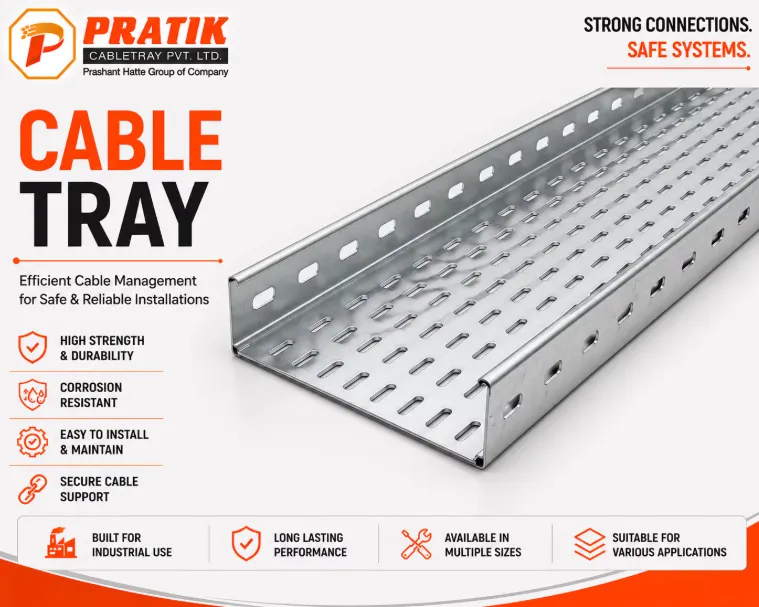
Selecting cable trays for a major electrical project is not the same as purchasing a standard consumable. The supplier may need to support multiple sizes, accessories, project specifications, staged quantities, documentation, and delivery schedules.
For EPC companies and procurement teams evaluating Cable Tray Suppliers Maharashtra, price should therefore be considered alongside manufacturing capability, specification compliance, consistency, and project coordination.
Begin With Technical Compliance
The first evaluation should determine whether the supplier can manufacture according to the project's actual technical requirements.
Prepare a clear specification covering relevant parameters such as:
- Cable tray type
- Material
- Dimensions
- Thickness
- Surface finish
- Required accessories
- Quantity
- Drawings
- Project-specific requirements
A quotation based on incomplete specifications may appear attractive but can make comparison difficult.
Compare Like With Like
One of the most common procurement mistakes is comparing quotations that do not represent identical products.
Two cable tray quotations can differ because of material thickness, finish, dimensions, accessory scope, packaging, freight, or other technical factors.
Before comparing the commercial value, procurement teams should normalize the technical scope.
A lower quoted amount is not meaningful if essential components have been excluded.
Assess Manufacturing Consistency
Large industrial projects can require substantial quantities of cable trays over several deliveries.
Dimensional consistency matters because tray sections must connect correctly at site. Differences between batches can create alignment problems and increase installation work.
Procurement teams should therefore consider whether the manufacturer has appropriate fabrication processes and quality controls for repeat production.
Evaluate the Accessory Range
A supplier capable of providing straight trays but not the required bends, tees, reducers, couplers, or other accessories may leave the contractor managing several vendors for one cable route.
This can complicate coordination, particularly when accessories must match tray dimensions and finishes.
Evaluating the cable management package as a system rather than as individual products can simplify project procurement.
Review Project Coordination Capability
Cable tray requirements frequently change as engineering develops.
Route dimensions may be revised, quantities can change, or additional accessories may become necessary after coordination with mechanical and structural services.
For Maharashtra projects involving multiple stakeholders, clear communication between procurement teams, consultants, contractors, and the manufacturer can be valuable.
The supplier should be able to understand technical schedules and clarify manufacturing requirements before production.
Consider Delivery Planning
A large order delivered without regard to installation sequence can create unnecessary storage pressure at site.
EPC and infrastructure projects often benefit from planned deliveries based on work fronts, buildings, floors, or project phases.
Before finalizing the supplier, discuss expected manufacturing and delivery schedules in relation to site requirements.
Delivery commitments should be evaluated realistically rather than on speed alone.
Look at Total Procurement Impact
The effective cost of a cable tray package extends beyond the purchase price.
Potential indirect costs include:
- Site modification
- Delayed installation
- Missing accessories
- Incorrect quantities
- Rejected material
- Multiple freight movements
- Additional handling
- Reordering
- Coordination time
A technically appropriate and accurately supplied package can reduce several of these avoidable project costs.
Ask Practical Questions Before Finalization
A structured supplier evaluation can include questions such as:
- Can the required tray types be manufactured?
- Are project-specific dimensions possible?
- Can compatible accessories be supplied?
- How are technical requirements confirmed?
- Can quantities be supplied according to project phases?
- What documentation is available where required?
- How are specification changes handled before production?
These questions give procurement teams a broader basis for evaluation than unit price alone.
Pratik Cabletray Pvt. Ltd. serves cable management requirements from Pune for industrial and project customers in Maharashtra. The company works within a manufacturing environment where contractors, EPC companies, consultants, and procurement teams often require specification-based products rather than generic stock selection.
For project procurement, a suitable cable tray supplier is one whose manufacturing scope, technical understanding, product consistency, accessory availability, and supply planning align with the project's actual requirements.
Keywords